Enterprise Product Positioning & Sales Enablement
Procurement governance in music and media without slowing teams
Company
invenioLSI
Enterprise IT consulting firm with proprietary enterprise products. Now operating as separate entities following a de-merger.
Product
Procure-to-Pay (P2P)
Enterprise procurement governance solution
Role
Marketing Manager
Product & Digital
Audience
Senior procurement & finance leaders
Enterprise music and media companies
Timeline
Feb–May 2025
Concentrated positioning & enablement sprint
A focused sprint ahead of a broader productized launch.
Context & Problem
Decentralized purchasing without guardrails
Media enterprises operate in highly decentralized purchasing environments, where teams across productions and regions need to buy quickly to keep work moving. Day-to-day purchasing often occurred outside formal controls, leaving procurement and finance teams struggling to enforce governance without slowing creative work.
Buyer Challenges
Limited pre-spend visibility and approval control at the point of purchase made it difficult to catch budget overruns before they happened.
Manual procurement processes created significant administrative overhead and downstream clean-up for finance and procurement teams.
Decentralized purchasing environments made it difficult to enforce budget controls consistently across teams.
Fragmented systems and third-party integrations increased complexity, cost, and operational risk.
Positioning & GTM Challenges
Sales lacked a clear, repeatable way to communicate value as the solution evolved from a highly customized offering toward a more standardized product.
Customer proof was limited, making it harder to reinforce value in both sales conversations and demand generation efforts.
The solution needed clearer positioning within media procurement and finance workflows to differentiate it from standard SAP capabilities.
Objective
Make P2P market-ready for Media & Entertainment
Support adoption and pipeline growth for Procure-to-Pay by clarifying its market positioning, improving sales readiness, and building momentum for a broader productized launch, beginning with music labels and publishers.
Approach
An outcome-led narrative built on buyer reality
I partnered closely with senior Presales and Sales leaders to draw on their direct experience with how procurement and finance buyers evaluated risk, governance, and operational friction. From there, I shaped a product narrative grounded in measured outcomes from invenioLSI customer implementations, with Universal Music Group as the flagship reference.
I prioritized giving Sales a clear, repeatable story they could confidently use in enterprise conversations, backed by proof-led content and demand gen around key industry events.
From a bespoke implementation story to a scalable governance narrative: procurement that moves fast and stays in control.
Strategy & Execution
Turning the positioning into a sales-ready motion
Positioning Decisions
Build a repeatable story before productization
The solution was still evolving from a customized implementation toward a standardized product. Rather than waiting for the product to stabilize, I built a narrative that could hold across the transition, giving Sales something consistent to use while the product continued to evolve.
Lead with purchasing control outcomes over procurement capabilities
Conversations with Presales and Sales helped identify which outcomes mattered most to finance and procurement leaders, specifically confidence that spending stays within bounds and prevention of budget overruns across decentralized teams. These insights shaped the positioning around 'no budget, no spend' as the central control principle, with messaging that prioritized those outcomes.
Unique Value Proposition
Procure-to-Pay is a native SAP solution built for media organizations, requiring no complex integrations. It enforces procurement control across decentralized teams, reduces procurement costs by up to 50%, and cuts administrative workload from 80% to 20%, while freeing creative teams from procurement burdens.
Figures based on validated customer data.
Primary Buyers
Senior procurement, finance, and operations leaders
CPOs, CFOs, CIOs, Heads of Business Affairs, and Supply Chain & Operations VPs
BUYER PERSONA EXAMPLE
Representative persona from a broader buyer persona deck.
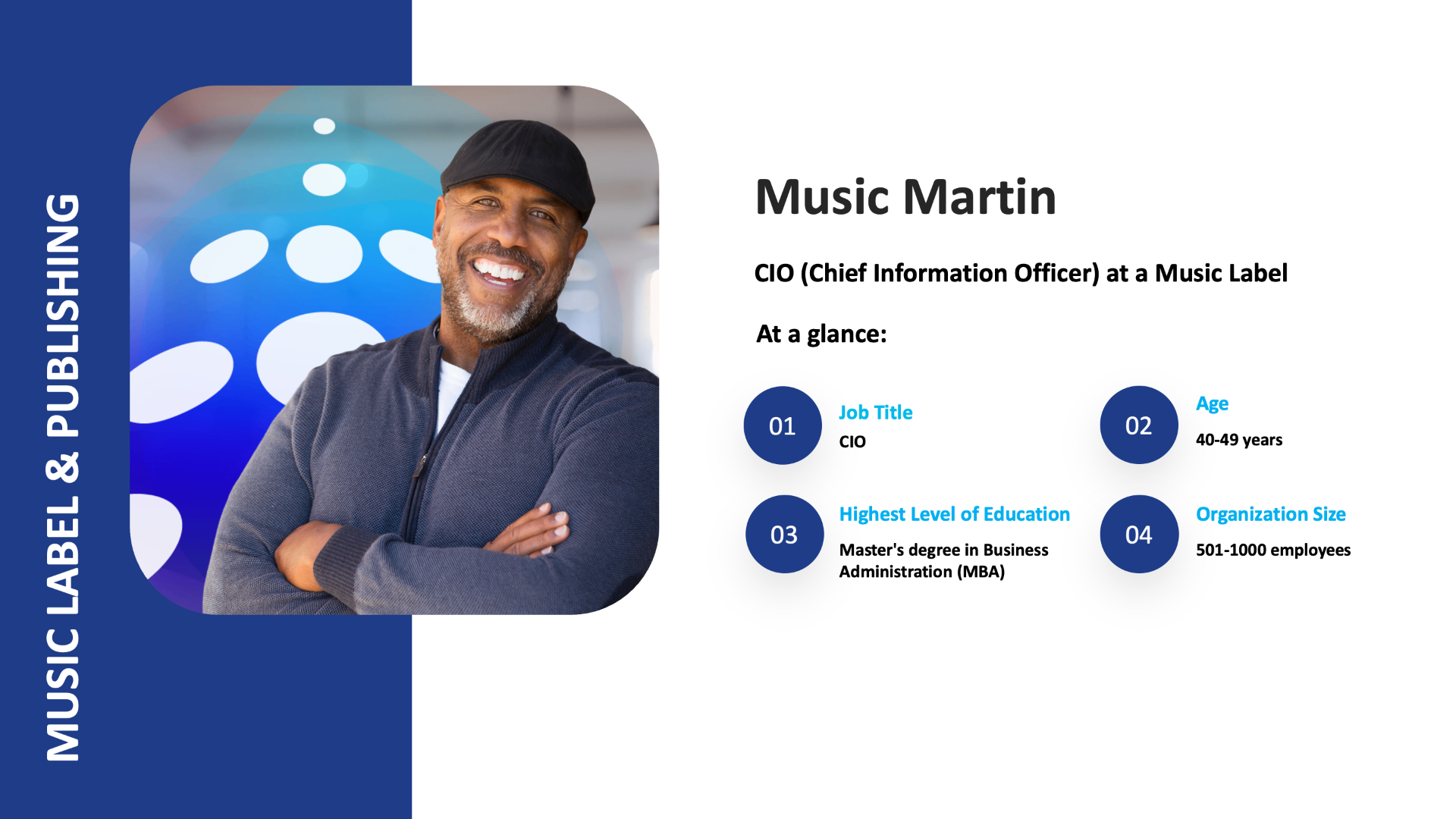
Music Martin
CIO at a Music Label
Messaging Pillars
Messaging emphasized support for creative and operational teams while giving finance and procurement teams confidence and predictability.
Pre-spend budget control & visibility
'No budget, no spend' enforced at the point of purchase, with real-time visibility into commitments, approvals, and supplier activity across teams and territories.
Purchasing autonomy without budget risk
Creative and operational teams can purchase quickly and keep work moving across productions and regions within established controls.
Reduced administrative burden
Automated workflows and minimized downstream reconciliations free finance and procurement teams from manual clean-up.
Stronger supplier relationships
Standardized, approved purchasing workflows reduce supplier friction, compliance complexity, and queries, leading to more reliable and consistent relationships.
GTM Channels
Owned content built the narrative and established credibility, while sales-supported outreach and events opened and advanced enterprise conversations.
Owned content
- Product website pages and ongoing content updates
- Blog content tied to customer procurement challenges
- SEO and content mapping
Direct & sales-supported
- Sales-supported outreach
- LinkedIn (organic and paid)
- Industry events and timed follow-up content
Core Assets & Enablement
Enablement approach
I developed content to support demand generation, customer proof, and enterprise buying conversations, with clear guidance to help Sales identify the right content and proof points for each opportunity.
With limited referenceable customers, I prioritized making existing proof work harder by leading with the UMG case study and proposing lighter-weight formats like use cases and outcome summaries when customers couldn't participate in formal case studies or press releases.
Key examples
Universal Music Group case study
Customer proof demonstrating procurement governance and operational efficiency within a complex multi-territory enterprise environment, including a rollout across nine countries and over 4,000 internal users.
Procure-to-Pay 2-pager
Sales enablement asset clarifying pre-spend control, procurement visibility, and admin workload reduction.
Supporting assets
Product overview page & solution messaging
Web content supporting discovery, positioning, and enterprise buying conversations.
Impact
From loosely positioned solution to market-ready offering
Closed deal
$1.25M
Supported a new logo win that opened a multi-million-dollar expansion into the parent company.
Contract renewals
$4M+
Supported contract renewals, with positioning and enablement materials used in retention conversations.
SALES CONFIDENCE
Established an outcome-led narrative that gave Sales confidence in early-stage conversations and laid the foundation for scaled GTM efforts.
Learnings
What this work reinforced
Start with the customer, not the product
Building the positioning around buyer priorities meant the narrative reflected real concerns rather than internal product logic. It also helped focus the product direction around what actually mattered to the market.
Emotional resonance is the next layer
Looking ahead, I'd push the messaging further by leading with a more specific emotional hook: not just 'pre-spend visibility' but the moment purchasing spins out of control across dozens of teams and territories, and what it takes to get ahead of it.
Enterprise customer proof requires flexibility
With few referenceable customers, formal case studies and press releases weren't always possible. Having lighter formats like use cases and outcome summaries ready as a second option kept proof moving when full formats stalled.